
FedEx Open de France: The Seven 65s Hidden Under a 63
**মূল উত্তর:** মাইকেল কিম ফেডেক্স ওপেন দে ফ্রান্সের প্রথম রাউন্ডে বোগি ছাড়া ৮-আন্ডার ৬৩ স্কোর করেন, আটটি বার্ডিসহ, এবং সাতজন ৬৫-স্কোরারের চেয়ে দুই শটে এগিয়ে থাকেন। স্ট্রোকস গেইনড বা ওয়ার্ল্ড র্যাংকিং ডেটা না থাকায় এই লিডের কৌশলগত ভিত্তি এখনো বিশ্লেষণযোগ্য নয়। **মূল তথ্য:** - মাইকেল কিম প্রথম রাউন্ডে ৬৩ স্কোর করেন — ৮-আন্ডার, বোগি ছাড়া, আটটি বার্ডি। - সাতজন খেলোয়াড় ৬৫ স্কোর করেন এবং দুই শট পিছনে যৌথভাবে দ্বিতীয় স্থানে আছেন। - ম্যাট ফিটজপ্যাট্রিক প্রকাশিত ফিল্ডের সর্বোচ্চ স্তরের খেলোয়াড়, তিনিও ৬৫ নিয়ে দুই শট পিছনে। - টুর্নামেন্ট এবার লে গলফ ন্যাশনালে, যা সংস্কার করা হয়েছে; গত আসর হয়েছিল গলফ দ্য সাঁ-নম-লা-ব্রেতেশে। - কভারেজ প্যাকেজে ফেডেক্স সেন্ট জুড চ্যাম্পিয়নশিপের ভিডিও ক্যাপশন মিশে গেছে, যেটি ভিন্ন Tournaments. **সূত্র:** এপি ওয়্যার রিপোর্ট, ফেডেক্স ওপেন দে ফ্রান্স প্রথম রাউন্ড কভারেজ; স্টেজ-১ তথ্য বিশ্লেষণ। **সম্ভাব্য ফলো-আপ প্রশ্ন:** প্রশ্ন: মাইকেল কিম কি শিরোপা ধরে রাখতে পারবেন? উত্তর: এক রাউন্ডের নমুনায় এটি নির্ধারণ করা যায় না; ৩৬ হোল পূর্ণ হলে ছবি স্পষ্ট হবে। প্রশ্ন: দুই শটের লিড কতটা নিরাপদ? উত্তর: সাতজনের চেজিং প্যাকে দুই শট অস্থির, কারণ এক হোলেই ব্যবধান শূন্য হতে পারে। প্রশ্ন: লে গলফ ন্যাশনাল কেন গুরুত্বপূর্ণ? উত্তর: ২০১৮ রাইডার কাপ ও ২০২৪ প্যারিস অলিম্পিকের ভেন্যু হিসেবে এটি ইউরোপীয় গলফের একটি Founded সম্পদ।
Two numbers sit side by side on the leaderboard at Le Golf National after Round 1. On top, Michael Kim — 8-under 63, bogey-free, eight birdies, zero bogeys. Two shots back, seven names, every one of them 65. In the newsroom's language the top number is the story. In the language of my ledger the bottom number is worth more, because seven matching 65s say the course was attackable on day one, and a two-shot gap is never as safe as it reads on paper.
In 2026, at the Asian Tour's Bangladesh Open, I walked four rounds with a scoring tablet, logging every drive, approach and putt for the statistics desk feeding the international world feed — more than 1,100 shot records from a tournament nobody asked me to document. I kept the file anyway. That week fixed my rule: a golf story opens with at least three numbers. Today's three are 63, 65, and seven.
Start with context. The FedEx Open de France is one of continental Europe's oldest national opens and historically a flagship slot on the DP World Tour calendar. This edition sits in a different equation — last year the event was staged at Golf de Saint-Nom-La-Bretèche, this year at Le Golf National, and the course has been renovated. That single sentence splits the analytical value of the week in two.
Le Golf National is not an ordinary venue. It hosted the 2026 Ryder Cup and the 2026 Paris Olympic golf competition. Those two data points turned it into an institution in European golf: precise, punishing, positioning-led, a test where accuracy beats raw distance. Which raises the obvious question — how did seven players shoot 65 on a Ryder Cup and Olympic course in the first round?
The answer hides in two places. One, renovation. Renovation plans are almost never written to punish players; they are written for spectator experience, ticket revenue, broadcast-friendly camera lines and sponsor hospitality. Two, the opening-day setup and weather. Soft greens, benign wind, generous pin positions — when all three align, a course's reputation and its actual difficulty separate. That is the trap in course-fit analysis: anyone who models Le Golf National as a hard course and ignores the Round-1 leaderboard will be proven wrong by the leaderboard itself.
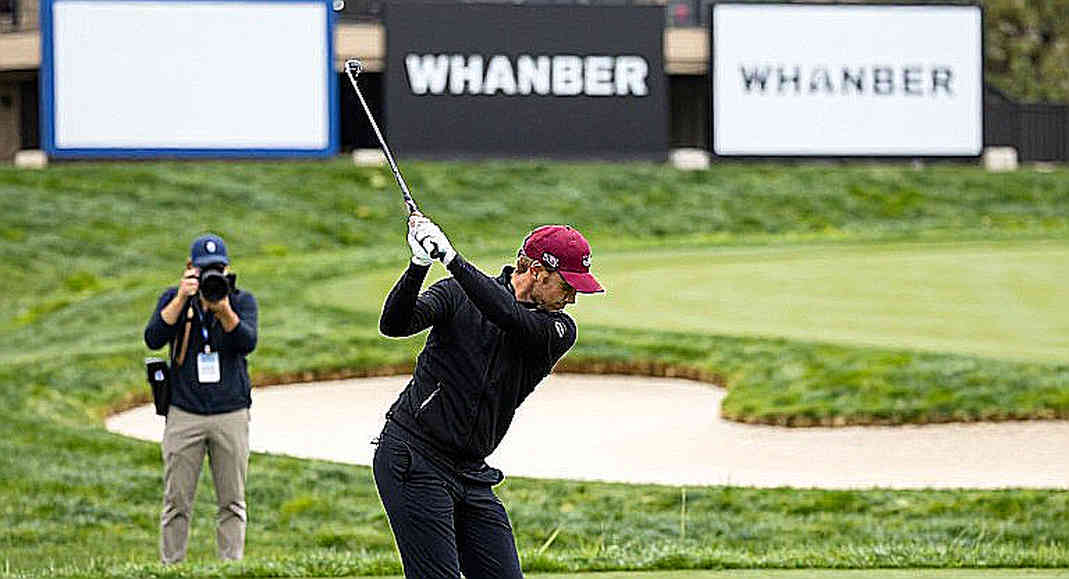
None of which lets me discount Kim's 63. Against golf's high-variance baseline, a bogey-free round carries more information than a six-under round, because zero bogeys means no blow-up hole, no dependence on scrambling in a single segment, no three-putt to repay. It is a control signal.
But control from where — driver, iron, or putter? That requires Strokes Gained data, and there is none. Without segment-level breakdown I cannot say whether Kim gained off the tee or had the classic hot putting week. Putting is the most volatile and least extrapolatable metric in the sport. A round that stays bogey-free on the back of the putter can become a 72 the next morning.
The seven 65s say something else. Kim leads by two, but his rival is not one player — it is seven, with a denser layer behind them. A two-shot lead in golf can be erased on a single hole: one eagle against one bogey and the margin is zero. When the chasing pack is a cluster, a lead is defended with scoring, not cushioning. On an attackable course, protective play means falling behind.
This is where the headline and the course separate. The headline says: defending champion leads. The course says: the most consequential name sits two back at 65 — Matt Fitzpatrick, the highest-tier player in the disclosed field, a major-champion-calibre entry. After 18 holes, the question is not how far ahead Kim is. The question is whether he can hold.
I treat the defending-champion tag separately. As a personal achievement it is significant; as a strategic advantage it is close to zero, especially when an event changes venue and the course is renovated. A defending title on a renovated, relocated course carries no course-history data. Any model built on last year's scoring pattern is running on a bad input.
The field composition matters too. Several of the contenders two back are in career-rebuild mode, players chasing status back on the DP World Tour. A player in that position tends to produce low-variance, patient Sunday rounds — the most annoying kind of opponent for a leader, because the pressure to avoid error lands on the man in front.
Here I want to pull one comparative thread, because the distance from Paris to Dhaka is a measuring instrument. Le Golf National built its market value by putting two global events on one property — the 2026 Ryder Cup and the 2026 Olympics. Bangladesh built the opposite: nineteen courses, only five with eighteen holes, nearly all behind cantonment walls. A national open can rotate venues because alternatives exist. Ours has walls instead of alternatives.
And the prize-money ledger shows the difference more nakedly. This event carries a global sponsor in the title slot. On the domestic BPGA circuit, a winner's cheque hovers around Tk 145,000. That is not a complaint, it is arithmetic: one sport, two economies, and between them an empty cell in the rights column.
That empty cell matters. The broadcast schedule is the quiet engine under every rights valuation. At Le Golf National there is four-day live coverage, camera towers, a world feed, Strokes Gained data — so the analyst has a door into the inside of the round. Where no verified live telecast exists, the score arrives at night and the explanation never arrives at all. That is a product failure before it is a media failure.
Now the part this coverage package carries inside itself. An embedded video caption in the Round-1 report describes a 116-yard approach on No. 1 at the FedEx St. Jude Championship. St. Jude is a different tournament, a different tour, a different week. The package has blended two events. It looks minor, but for anyone tempted to infer scoring data from video frames, it is contaminated input. My rule is plain: I do not trust a number until it survives the ledger test, and this caption does not.

The risk side is clearer still. A two-shot lead, seven players behind, an attackable course, and a forecast capable of turning — those four factors push the risk rating from medium toward high. Le Golf National is an exposed property; if heavy weather arrives, scoring compresses. The question then becomes whether Kim's 63 was a hard-condition score or a soft-condition score, and whether zero bogeys reflected control or simply a generous setup.
I am waiting for Strokes Gained data. Once 36 holes are complete, the picture may look entirely different. What is safe to say now: in front of a broad chasing pack, a two-shot lead is not a duel lead, it is a dispersion lead. In a duel you watch one opponent's score. In a pack you watch eight rows of a table, and in golf that is close to impossible.
On Fitzpatrick, one more point. A player of his tier appearing at a DP World Tour co-sanctioned event usually means one of two things: an event-minimum obligation, or Ryder Cup season preparation. Both produce slightly under-tapered entries with a very high ceiling. A first-round 65 is exactly that signal — not maximum preparation, maximum capacity.
To the broadcast-economics side, one caution — because the easiest trap for a golf analyst is optimism about future revenue. A title sponsor, a historic venue, a major champion in the field: all genuine assets. None of it licenses an invented ratings or carriage figure. Where verified audience data does not exist, the analyst's job is to cost the build and name the strategic necessity, not to forecast the upside.
On Wednesday night I will update the ledger: 63, 65, seven. If after Round 2 more than ten names sit within three shots, Kim's probability falls and Fitzpatrick's rises. In golf modelling my most useful sentence is this: one round is not a trend, one round is a single observation.
The reader's question should not be about Kim. It should be: over 54 more holes on an attackable Le Golf National, who makes the fewest mistakes? The answer is in the numbers. The numbers are not written yet.